Want a 350% ROI?

Cathie Leimbach • November 11, 2020

I’ve got the investment for you! And, it’s not too good to be true. It really does yield a 350% ROI! And, it’s legal!


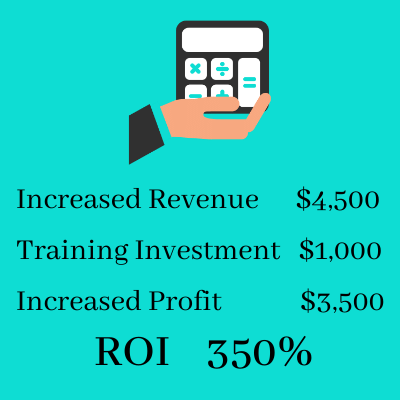
This investment is training!! On average, one dollar invested in training increases the bottom line by $4.53, yielding a 353% return.


What is the catch? To yield a strong return the training has to be relevant to your organization’s needs. It must meet 3 criteria:

  •  result in trainees learning new knowledge and developing new skills,
  •  have job impact, be relevant and be used at work after training,
  • improve the organization’s bottom line.


What is limiting your bottom line? Which of your current challenges would be reduced if your employees interacted, behaved, or worked differently? Training could be the solution. 


Many of the 385,000 open job positions in manufacturing are paying new hires $40,000 per year. These positions remain unfilled because job seekers lack skills in manufacturing fundamentals or robotics. Vocational schools and community colleges offer such training but enrolment is low.


Many small businesses are always short-handed. Their staff are getting burned out. Managers are reluctant to hire job applicants who are weak in workplace fundamentals. Personal Leadership Effectiveness™ training is available to help individuals become more reliable, positive, and productive so they add value at work.


Most people are doing the best job they can with their current knowledge and skills, but due to their lack of know-how they may be achieving less than half of their potential. Their supervisors are too busy with other responsibilities to coach them. The HR department is prioritizing administration above training. The company could increase its bottom line by $3,500 for every $1,000 invested in relevant training.


90% of managers lack effective leadership skills. Most staff who leave a company do so to escape one of these bad managers. Effective management training leads to enhanced employee engagement and can increase the organization’s bottom line by 50% or more. The Conversational Management™ program can generate such an impact. 


Would you like to improve your company’s bottom line by meeting the needs of more customers and helping all employees add value? Then, first, it’s time to identify the gaps in staff knowledge, skills, and behaviors. And, second, invest in training that will produce win/win results for staff members and the organization.


Contact Cathie Leimbach to discuss needs assessment strategies and effective ways to enhance leadership, team player, and soft skills competence within your organization so employees are equipped to achieve profit and impact goals.


By Cathie Leimbach November 25, 2025
As leaders, we know Thanksgiving week is prime time for employee appreciation. But here's the thing—a generic "thanks everyone" email hits differently for different people. Dr. Paul White's research on the 5 Languages of Appreciation in the Workplace offers a smarter approach. Just like people receive love differently, your team members feel valued in distinct ways: through words of affirmation, quality time, acts of service, tangible gifts, or physical touch (think handshakes and high-fives in professional settings). That all-star on your team? She might light up from a handwritten note praising her specific contributions. Your behind-the-scenes problem-solver might feel more appreciated if you help him out by clearing his schedule for an afternoon so he can tackle his backlog. This Thanksgiving, skip the one-size-fits-all approach. Take ten minutes to consider how each team member prefers to be recognized. It's not about grand gestures—it's about matching your gratitude to what actually resonates with each individual. When appreciation lands in someone's preferred language, it doesn't just feel nice. It builds loyalty, boosts morale, and reminds people why they show up every day. That's something worth being thankful for. Curious about what languages are preferred? Click here to learn more!
By Cathie Leimbach November 10, 2025
In most organizations, the instinct is to add —more goals, more projects, more meetings. But as Juliet Funt, founder of the Juliet Funt Group, teaches in her Strategic Choice process, real leadership strength lies in deciding what to stop doing . Strategic Choice is the intentional narrowing of priorities—cutting away the clutter so teams can focus on what truly drives results. It’s a disciplined act of letting go: saying no to good ideas so there’s room for the great ones. Funt’s approach challenges leaders to pause, think, and create the mental and operational space their people need to perform at their best. By removing unnecessary tasks and misplaced effort, leaders make room for precision, innovation, and real thinking time. This isn’t about doing less—it’s about doing what matters most. When businesses adopt this mindset, they replace overwhelm with clarity and regain control of their time, energy, and outcomes. For small to mid-sized companies, embracing Strategic Choice can transform busyness into focus—and that focus is where sustainable growth begins. Want a quick visual overview? View Strategic Choice: Making Room for What Matters to see how this process helps leaders focus on what truly drives results.